

By CEO: Ludmila Baklanova
Most companies start a digital transformation expecting faster operations and better information to run the business on. Many never see either. The new system launches, but employees keep working around it, and the gains promised in the business case stay on paper. Costs go well past the budget. Leadership has spent months on a project that changed very little, and the next initiative starts with a workforce that has learned to be skeptical.
A digital transformation can succeed technically and still fail as a business initiative. Boston Consulting Group (BCG) research found that 70% of digital transformations fall short of their objectives. In most cases of digital transformation failure, the software isn’t the problem. The trouble sits in the gap between what the business needs and how work actually gets done.
That’s why Optimize Tech Consulting starts every engagement with the business problem and treats the technology decision as something that follows. In this post, we cover where transformations most often break down and the approach we use to keep them tied to measurable results, so your next initiative delivers the value it was funded to deliver.
Why Do Digital Transformations Fail?
Digital transformations most often fail because the organization treats the software rollout as the transformation itself. A new platform can’t repair a broken workflow or settle who owns a decision. If the data is unreliable going in, it stays unreliable after launch, and a system people don’t trust won’t fix adoption on its own.
The harder part is that a real transformation changes how the business operates day to day. Information travels along new paths, and teams that used to work in parallel start depending on one another. Technology should be built around that operating model. When the business reshapes itself to fit the software instead, the project can launch on time and still miss the point.
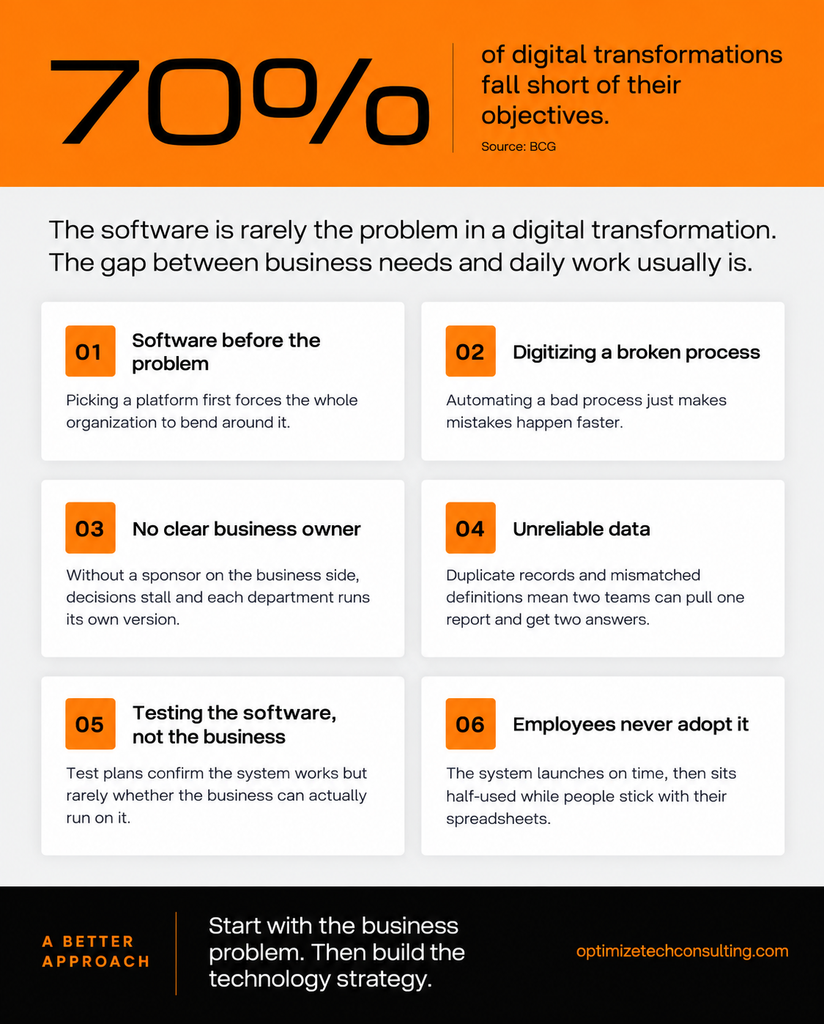
Common Reasons Digital Transformations Fail
The causes are rarely technical. Below are the most common reasons we see transformations stall.
Starting with the Software Instead of the Business Problem
From our experience, this is where many transformations go wrong before they start. A company picks a platform first and then asks the organization to bend around it. 93% of business leaders are investing in more technology, but that doesn’t necessarily mean they see an ROI. The better sequence starts with understanding the problem and how the work gets done today. Once the desired outcome is clear, the technology requirements tend to follow.
That doesn’t always mean buying something new. Often the better answer is to:
- Optimize a platform the business already owns
- Integrate systems that don’t talk to each other
- Automate a few high-value processes
- Replace technology only where it’s holding the business back
Digitizing a Broken Process
McKinsey tested 25 organizational factors against whether companies saw bottom-line impact from generative AI. In their tests, they found that redesigning workflows mattered more than any other. Automating a bad process just makes mistakes happen faster. If an approval already passes through people who don’t need to see it, a workflow tool just moves those handoffs onto a screen. Before automating, find where work stalls or gets duplicated and decide which steps are worth keeping.
Related: How to Streamline Business Operations with Project Management Tools
Unclear Ownership and Weak Executive Sponsorship
PMI found that one in four organizations names inadequate sponsor support as the primary cause of failed projects. Among the weakest performers, that number climbs to 41%. Transformations can’t belong to IT alone. Someone on the business side has to own the outcomes and make the cross-functional calls no single department can make. Without that person, decisions stall, and each department ends up running its own version of the same process.
Poor Data, Integrations, or System Configurations
Data problems are easy to miss because the system itself looks fine. When records are duplicated, or definitions don’t match, two departments can pull the same report and get different answers. The issue grows as companies invest in AI and automation, which depend on reliable, structured data to work correctly. In fact, 34% of companies say that their data is inadequate to support a seamless digital transformation, further proving the importance of configuring internal information prior to introducing new software.
Inadequate Testing Before Launch
Many test plans check whether the software works. Fewer check whether the business can actually run on it. That takes real scenarios and the people who’ll use the system every day. Can a salesperson close a deal from start to finish? What happens when someone rejects an approval halfway through?
Employees Do Not Adopt the New Process
It’s common for a system to launch on schedule and then sit half-used while employees stick with their spreadsheets. Surveys show that 59% of companies found that user adoption is one of the top reasons digital transformation fails. Top management is responsible for driving software adoption and ensuring the organization accepts the operational change. Training helps, but people also need to understand why the change is happening and how it affects their own work. Those conversations should start well before launch, while there’s still time to act on what you hear.
Going Live Does Not Mean the Transformation Succeeded
Many companies treat launch day as the finish line in digital transformation. In a McKinsey global survey, only 16% of respondents said their digital transformations improved performance and sustained it. Another 7% saw gains that didn’t last. A successful go-live means you implemented the technology. Whether it improved anything is a separate question, and you can only answer it after launch.
Start by tracking the outcomes the project was supposed to change:
- Adoption, since a system people avoid can’t deliver on anything else
- How long key processes take to complete
- Error rates and data quality
- Revenue and customer experience, when they were part of the business case
Those results will tell you where the next round of optimization should focus.
A Better Approach: Start with the Business, Then Build the Technology Strategy
Our work at Optimize Tech Consulting follows a sequence designed to keep the business problem in front of the technology decision.
- Understand the business problem: Clarify what isn’t working or could benefit from improved workflow, and what it’s costing the business, before anyone mentions a platform or software.
- Document the current state: Map how work actually moves today, including the manual steps and workarounds that never show up in a process diagram.
- Define the future state: Describe how the business should run after the change and which measurable outcomes should improve.
- Prioritize by business value: Weigh each opportunity by its value and the operational pain it causes, then factor in risk and dependencies. Some processes aren’t worth digitizing yet.
- Evaluate the technology you already have: Many systems can be optimized or better integrated, often for less than a replacement would cost. Replace only what can’t be fixed.
- Implement in phases: Smaller releases deliver value sooner and give users a chance to push back before problems are locked in. Testing and change management belong in every phase.
- Measure and keep improving: Use the post-launch metrics above to decide what to adjust next.
What Successful Digital Transformation Looks Like
In one of Optimize Tech Consulting’s case studies, a client’s vendor and contract management process lived in inboxes and spreadsheets, and nobody could confidently say where a given contract stood. We helped replace it with a single integrated workflow that runs from the first intake request through renewal, with risk review and approvals handled along the way and a clear owner at every step. Most of the value came from connecting the process to the people and information it depends on.
Before Your Next Digital Transformation, Analyze the Problem with Optimize Tech Consulting
Too many transformation projects start with the question of which software to buy. A better first question is harder to answer: what business problem are we trying to solve, and what should “better” look like?
Once that’s clear, the order of work changes. Processes get fixed before they’re automated, and existing systems get a fair look before anyone signs a new contract.
If a transformation is on your roadmap, Optimize Tech Consulting can help you assess where your operations stand today and build a phased plan tied to measurable business outcomes. Schedule a consultation to discuss your business’s digital transformation today.
If you found this article helpful, consider reading “The Digital Transformation Checklist” next.